
Pool Fence
Frameless Glass Pool Fencing: What to Know Before You Plan a Project
A detailed guide to frameless glass pool fencing, covering panel selection, hardware systems, gate planning, substrate checks, compliance considerations, and ordering preparation.
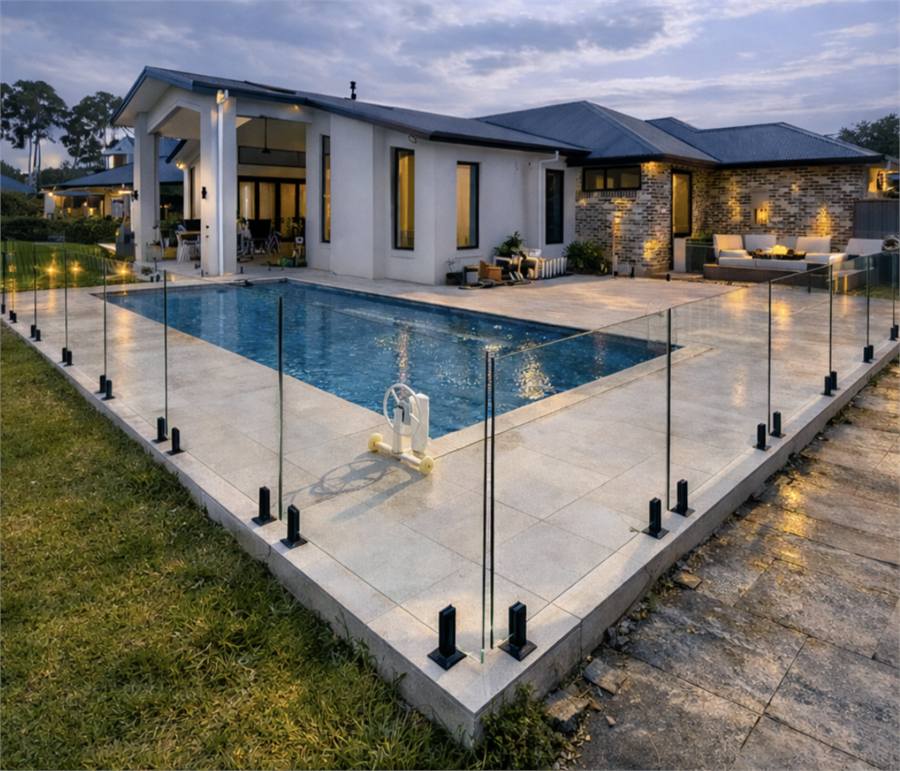
Frameless glass pool fencing looks simple when it is finished: clear panels, minimal hardware, open sightlines, and a clean edge around the pool. The work behind that result is more technical. A good pool fence project depends on panel selection, gate planning, fixing method, substrate condition, hardware compatibility, and the way every opening is measured before anything is ordered.
The biggest mistake is treating pool fencing as a set of glass sheets only. The glass, spigots, hinges, latch, gate panel, hinge panel, corners, and ground conditions all work as one system. If one part is chosen without checking the others, the install can become slower, less accurate, or more expensive than it needed to be.
This guide is written for builders, installers, landscapers, and homeowners who want to understand the practical decisions before planning a frameless glass pool fence. It explains what each panel type does, how hardware affects the project, and what to prepare before sending measurements for supply.
Start With the Fence Line, Not the Glass
Before selecting panel sizes, map the entire fence line as a sequence of straight runs, corners, gate openings, returns, steps, slopes, and any areas where the glass needs to follow a non-standard shape. This first drawing does not need to be beautiful, but it does need to show how the fence works in real space.
A straight run may be solved with standard fixed panels. A gate opening usually needs a gate panel, hinge hardware, latch hardware, and either a hinge panel or a strong adjacent fixing point. A sloped edge may need a raked panel. A curved deck edge may need curved or custom glass. Corners may need careful panel spacing so the finished line looks intentional rather than patched together.
The layout should also show the pool edge, deck edge, walls, steps, landscaping, and any nearby structures. These details matter because pool fencing is not only about filling a distance with glass. It also needs to work around access, gate swing, visual alignment, drainage, and the practical movement of people around the pool area.
Understand the Main Pool Fence Panel Types
Pool fencing normally uses toughened safety glass designed for outdoor barrier applications. The exact panel type depends on its job in the fence line. A fixed panel is used for the main continuous sections. A gate panel is prepared for gate hardware and movement. A hinge panel is used where glass-to-glass gate hinges need support. Raked panels are used on slopes, and curved panels are used where the fence line follows a radius.
KKX pool fence fixed panels and hinge panels include 12mm clear toughened glass options, while gate panels are supplied for compatible gate hardware systems. Standard sizing is useful because it gives installers predictable options and faster planning. Custom glass becomes important when the site has an unusual opening, a sloped path, a curved deck, or a design that cannot be solved cleanly with standard widths.
When comparing panel types, do not look only at width and height. Check edge finish, corner radius, hole or cut-out requirements, compatibility with hardware, and whether the panel is being used as a fixed barrier or as part of a moving gate system. A panel that looks close in size may still be the wrong choice if it has the wrong preparation for the hardware.
Choose Hardware as Part of the System
Hardware is not just decoration. It controls how the glass is fixed, how loads transfer into the ground or structure, how the gate moves, and how the finished pool area feels. Spigots are common for frameless pool fencing because they keep the glass line light and open. Channels can create a continuous base detail. Hinges, latches, clamps, and brackets need to be selected around the gate layout and fixing conditions.
The fixing method should be chosen after checking the substrate. Concrete, tiles over concrete, timber decking, steel structure, and stone surfaces can all require different fixing considerations. A beautiful hardware system will not perform properly if it is installed into an unsuitable base or if the fixing depth, packing, drainage, or waterproofing details are ignored.
Finish is also part of the design. Stainless steel is a clean, durable option for many pool environments. Matte black can create a stronger architectural line. Other finishes may be chosen to match balustrades, window frames, outdoor kitchens, or landscape features. The best finish is the one that works visually while still being practical for the exposure and maintenance expectations of the project.
Give the Gate Zone Extra Attention
The gate is usually the most technical part of a pool fence. Fixed panels only need to stand in position, but a gate has to move, self-close where required, align with the latch, and remain stable through repeated use. That means the gate zone needs more planning than the average fixed panel run.
Start by deciding the gate location and swing direction. Then check what the gate will hinge from: a wall, post, hinge panel, or adjacent glass panel. The answer affects the hinge type and the glass preparation. Next, plan the latch side and make sure the receiving point is suitable. The gap around the gate must be planned carefully because a gate that is too tight can rub, while a gate that is too loose can look unfinished or fail practical expectations.
Gate hardware should be treated as a matched set rather than mixed randomly. Hinges, latch, gate panel, and hinge panel need to work together. This is where clear product information and consistent hardware supply help installers avoid site delays.
Plan Around Ground Levels, Slopes, and Curves
Many pool areas look flat at first glance, but small level changes can create real issues once glass is installed. A run that is level at one end may climb or fall across the deck. Steps, paving falls, coping edges, drainage channels, and garden beds can all affect panel selection.
A raked panel is useful when the glass needs to follow a slope or transition between heights. It can make the fence line look cleaner than forcing rectangular panels into an area where the ground is not level. Curved panels are different: they are used when the plan view of the fence needs to follow a radius rather than a straight line. These panels are more specialized and should be planned earlier because they affect lead time, measuring, and cost.
If the site has slopes or curves, photos are extremely useful. A supplier can understand the project faster when the measurements are supported by clear images of the ground, the pool edge, and the proposed fence line.
Measure for Ordering, Not Just for Estimating
Early measurements are useful for estimating, but ordering measurements need more discipline. Measure each run separately. Mark gate openings clearly. Note whether dimensions are taken from wall to wall, edge to edge, centreline to centreline, or between proposed fixing points. If a measurement is taken from a tiled edge or coping edge, record that too.
For straight runs, list the total opening, preferred panel split, and any fixed points that cannot move. For gates, record the clear opening, hinge side, latch side, swing direction, and adjacent panel type. For slopes, record the high point and low point. For custom panels, provide a drawing with all relevant dimensions rather than one single overall size.
Good measurement notes reduce back-and-forth. They also help avoid the common problem where a panel technically fits the opening but does not leave the right gaps, hardware position, or visual alignment. The goal is not only to buy glass that fits. The goal is to buy a system that installs cleanly.
Keep Compliance in the Conversation
Pool fencing is a safety product, so compliance needs to be considered from the start. Glass quality, panel height, gate operation, latch position, climbable zones, and local rules can all affect the final result. Requirements can vary by location and project type, so the installation should always be checked against the relevant Australian standards, local council requirements, and site-specific conditions.
A supplier can help with product selection, glass options, and hardware compatibility, but final compliance depends on the complete installed barrier. That includes the glass, hardware, fixing method, gate operation, surrounding ground levels, nearby objects, and the way the barrier interacts with the pool area.
For professional installers, it is worth raising compliance questions before ordering. For homeowners, it is worth involving a qualified installer or certifier early if the site has unusual levels, steps, retaining walls, boundary conditions, or nearby structures.
What to Prepare Before Contacting a Supplier
A strong enquiry should include a simple fence layout, total dimensions for each run, gate location, photos of the site, preferred hardware finish, substrate details, and any custom requirements. If the project includes raked or curved panels, include extra photos and mark the high and low points or radius direction clearly.
A good ordering list usually includes each fixed panel size, gate panel size, hinge panel size, raked or curved panel requirements, spigot or channel quantities, hinge and latch requirements, corner details, and finish preference. For trade projects, this list can be turned into a faster supply schedule. For homeowners, it gives the supplier enough information to respond with practical options rather than generic advice.
KKX supplies pool fence glass, gate panels, hinge panels, raked and curved panel options, plus matching glass fixing and pool gate hardware. If you are planning a pool fence project, the best next step is to collect the measurements, take clear photos, and match the glass and hardware as one complete system.
Frequently Asked Questions
What glass is commonly used for frameless pool fencing?
Frameless pool fencing commonly uses toughened safety glass selected for barrier applications. KKX pool fence fixed panels and hinge panels include 12mm clear toughened glass options, while gate panels are matched to suitable gate hardware systems.
When do I need a raked pool fence panel?
A raked panel is useful when the fence line follows a slope, step, or changing ground level. It helps the glass line follow the site more cleanly than forcing standard rectangular panels into an uneven area.
Are spigots the only option for frameless pool fencing?
No. Spigots are very common, but some projects may use channels, clamps, or other fixing systems depending on the substrate, visual detail, and installation requirements.
Can pool fence glass be custom made?
Yes. Standard sizes suit many projects, but custom panels may be needed for curved areas, sloped ground, unusual openings, or a specific architectural detail.
What information should I send when asking for a pool fence quote?
Send a simple layout, dimensions for each run, gate opening details, hinge and latch direction, photos of the site, substrate information, preferred finish, and notes about any sloped, curved, or custom areas.